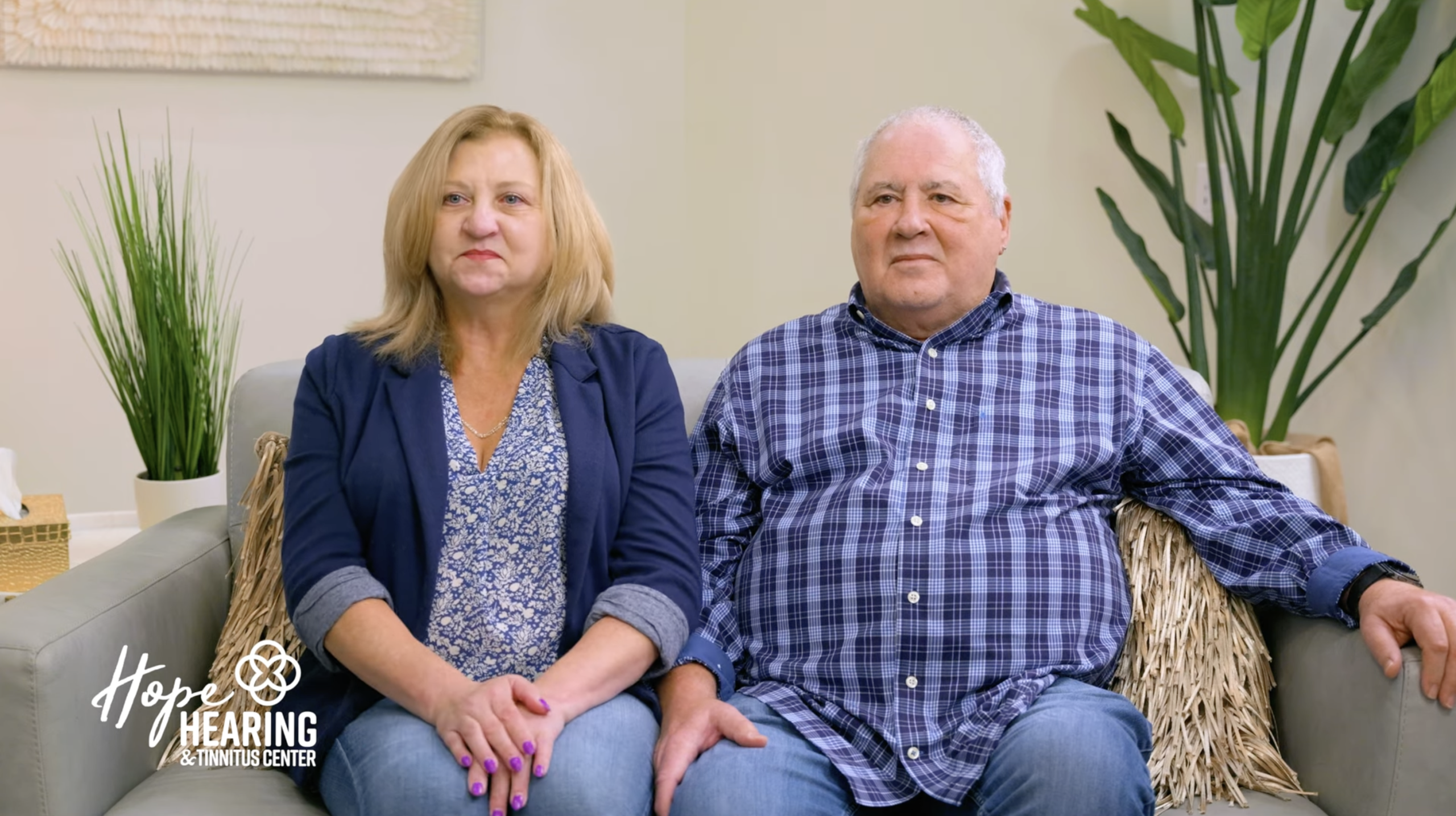

Meet Rich and Becky – Overcoming Tinnitus and Anxiety Together
My tinnitus started in December of 2022. I had a drug interaction, and I first noticed it about two or three minutes after my blood pressure went up. My ears started to ring. It was pretty loud, but I thought it would dissipate over time. I assumed once my blood pressure came back down, the ringing would stop.
We went to the ER. They focused on getting my blood pressure down and assured me everything else would resolve. They said once my blood pressure was under control, the ringing would return to normal. Nothing permanent would come from it. Maybe it would take a day or so for my body to settle down, but it would be okay.
One day passed, then two, then three. The ringing was still there, loud enough to let me know 24 hours a day that it was not going away.
How Tinnitus Affected My Daily Life
I started noticing it interfering more and more with my day-to-day life, with my ability to concentrate and my ability to think clearly. From the moment I woke up to the moment I tried to fall asleep, it was the center of my attention. It really began to affect my quality of life.
I went to the ENT, and they basically said, “Your hearing is okay. There’s really nothing we can do for you here.” That was it. I left with a thousand more questions than answers.
At 57 years old, I couldn’t believe this was going to be my life for another 25 or 30 years. You find yourself wanting to stop interacting with people. During phone conversations, you don’t focus on what others are saying because you’re so focused on the tinnitus and trying to block it out. You lose the ability to concentrate, and it alters the way you interact with people. For me, it became a downward spiral.
Tinnitus and Anxiety
Anxiety has always been a small part of my life. I took that SSRI, and within two minutes I could feel my jugular pounding. I knew my blood pressure was skyrocketing, and within that same two minutes the ringing started. It began faintly, but within a few minutes it was almost like a small train whistle blazing in the middle of my head, and it did not stop.
When My Tinnitus Came Back
I had tinnitus for about three months, and then it completely went away. When it returned in June of 2023, it was just as bad, if not worse.
I started researching online, being careful about what I read. I came across the story of William Shatner and tinnitus retraining therapy. He talked about being brought to the brink of suicide because of tinnitus, and then about his two-and-a-half-year journey to where it no longer affected his life. That gave me hope.
If doctors and ENTs can’t prescribe something or fix it with surgery, they often don’t have other solutions. You have to think outside that box, but there aren’t many places in the country that truly understand how tinnitus retraining therapy works.
Finding Hope
Through my research, I came across Hope Hearing & Tinnitus Center. That night, we were sitting at the dinner table, and Dr. Beki’s commercial came on. I thought, “This is a sign.”
The next day, I called Hope Hearing and scheduled my appointment for the end of November. From the moment she picked up the phone, you could tell they cared. They listened to my experience and gave me confidence that I had called the right place, that there was a solution, and that this wasn’t something I would have to live with forever.
She walked me through the entire process, including what wearing the devices would look like, what to expect at the first appointment, and the hearing test. About 80 percent of people with tinnitus have some level of hearing loss. I fall into the category where I don’t have substantial hearing loss, yet my tinnitus was severe.
The Devices and Progress
Don’t delay. It is not going to get better on its own. Don’t settle for masking it. Don’t just try to hide it—try to fix it.
The anxiety it causes is real. When you’re thinking, “I can’t take this today. If this gets worse six months from now, how can I live with this?” that’s overwhelming. But when you find a solution and a process that helps you move forward, it becomes manageable. It becomes controllable. Knowing there’s a path to getting better completely changes your outlook on life.
Don’t walk, run.
Dr. Beki and the entire team are phenomenal. They care. They don’t rush you. They do what’s best for you. You feel immediately that they care about you and want to make things better.
Because there is hope. There truly is hope. Tinnitus leaves so many people feeling hopeless. But when you walk through those doors, you feel hope from the staff, from every interaction. It literally puts hope back into your life.
At the beginning, tinnitus was part of every conversation I had. Now, I don’t even bring it up. My wife is usually the one who asks how it’s doing, and most days I realize I hadn’t even thought about it.
The anxiety it causes is real. When you’re thinking, “I can’t take this today. If this gets worse, how can I live with this?” That’s overwhelming. But when you find a process that helps you move forward, it becomes manageable and more controllable.
There is help. There is a way forward. And there is hope.
Moving Forward
Don’t delay. It is not going to get better on its own. Don’t settle for masking it. Don’t just try to hide it—try to fix it.
The anxiety it causes is real. When you’re thinking, “I can’t take this today. If this gets worse six months from now, how can I live with this?” that’s overwhelming. But when you find a solution and a process that helps you move forward, it becomes manageable. It becomes controllable. Knowing there’s a path to getting better completely changes your outlook on life.
Don’t walk, run.
Dr. Beki and the entire team are phenomenal. They care. They don’t rush you. They do what’s best for you. You feel immediately that they care about you and want to make things better.
Because there is hope. There truly is hope. Tinnitus leaves so many people feeling hopeless. But when you walk through those doors, you feel hope from the staff, from every interaction. It literally puts hope back into your life.
At the beginning, tinnitus was part of every conversation I had. Now, I don’t even bring it up. My wife is usually the one who asks how it’s doing, and most days I realize I hadn’t even thought about it.
The anxiety it causes is real. When you’re thinking, “I can’t take this today. If this gets worse, how can I live with this?” That’s overwhelming. But when you find a process that helps you move forward, it becomes manageable and more controllable.
There is help. There is a way forward. And there is hope.